Roasted Tomato Soup Bliss with Fresh Basil and Garlic

- Effort/Time: Low-effort roasting / 1 hour total
- Flavor Hook: Charred-sweet tomatoes meets buttery roasted garlic
- Perfect for: Budget-smart family dinners and make-ahead lunches
- The Molecular Magic of over High heat Roasting
- Ingredient Chemistry Breakdown
- The Alchemy of Umami: Selecting Your Elements
- Essential Tools for Thermal Mastery
- Precision Temperature Protocol: Key Steps
- Managing Common Pitfalls
- ⚗️ The Scaling Lab
- Debunking Common Tomato Myths
- Preservation and Zero Waste Philosophy
- Perfect Pairings for a Family Table
- Recipe FAQs
- 📝 Recipe Card
There is nothing more frustrating than spending $15 on beautiful produce only to have it turn into a thin, watery, and sharp tasting sludge that tastes more like warm juice than a meal. I’ve been there, staring at a pot of soup that lacked any soul or depth, feeling the sting of wasted time and money.
When you don't treat the ingredients with the right thermal application, the natural sugars stay locked away, leaving you with a metallic aftertaste that even a gallon of cream can't fix.
I’ll admit, early in my cooking journey, I used to think that boiling fresh tomatoes was the shortcut to freshness. I destroyed at least three batches of what should have been "fresh" soup before I realized I was fighting the physics of the fruit.
I ended up with a grainy texture and a sour profile that made my kids reach for the cereal box instead. It was a humbling lesson in how heat and specifically the type of heat is actually the most important ingredient in your pantry.
The secret to this Roasted Tomato Soup Bliss with Fresh Basil and Garlic isn't a "secret" ingredient; it’s the Maillard reaction triggered by the over high heat roasting of the 3 lbs Roma or Vine Tomatoes.
By roasting, we initiate pectin breakdown and sugar caramelization simultaneously, which creates a velvety texture and a mahogany colored depth of flavor. You aren't just heating the vegetables; you are fundamentally changing their molecular structure to transform sharpness into a concentrated, savory sweetness that coats the back of your spoon.
The Molecular Magic of over High heat Roasting
- Maillard Reaction: High oven heat rearranges amino acids and sugars in the tomatoes and garlic, creating hundreds of new flavor compounds that boiling simply cannot achieve.
- Pectin Gelatinization: Roasting breaks down the rigid cellular walls of the 3 lbs Roma or Vine Tomatoes, allowing the internal pectin to release and act as a natural, starch free thickener.
- Volatile Oil Extraction: The 3 tbsp Extra Virgin Olive Oil acts as a solvent, pulling fat-soluble flavor compounds out of the 1/2 tsp Red Pepper Flakes and garlic, distributing them evenly through the liquid.
- Aromatic Concentration: As the water evaporates during the 45 minutes of roasting, the "tomato ness" of the soup concentrates, resulting in a more intense sensory experience per spoonful.
Ingredient Chemistry Breakdown
| Ingredient | Chemical/Physical Role (Science) | The Pro Secret (Why This Matters) |
|---|---|---|
| 3 lbs Roma Tomatoes | Pectin rich structure and low water content | High solids-to-liquid ratio ensures a thick, velvety base without flour. |
| 1 head Garlic | Sulfur compound transformation via caramelization | Roasting turns pungent allicin into sweet, buttery vanillin like compounds. |
| 1 tbsp Balsamic Vinegar | Acid catalyzed flavor brightness | The acetic acid cuts through the heavy roasted notes to "wake up" the palate. |
| 2 cups Vegetable Stock | Liquid medium for emulsion | Provides the necessary hydration for the roasted solids to become a smooth suspension. |
The Alchemy of Umami: Selecting Your Elements
When it comes to making this Roasted Tomato Soup Bliss with Fresh Basil and Garlic, your choice of tomato is your foundation. I prefer Roma tomatoes because they have thicker walls and fewer seeds, which means more "meat" for your soup. If you’re looking for a similar flavor profile in a main dish, this technique of balancing acidity and sweetness is exactly what makes my Tomato Basil Pasta recipe a weeknight staple.
- 3 lbs Roma or Vine Tomatoes, halved Why this? Romas have lower water content, preventing a watery, diluted soup profile.
- 1 head of Garlic, top sliced off Why this? Roasting the whole head in the skin protects the cloves from burning.
- 3 tbsp Extra Virgin Olive Oil (like Bertolli or Lucini) Why this? Monounsaturated fats carry the fat-soluble aromas of the roasted herbs.
- 1 tsp Sea Salt (Diamond Crystal Kosher Salt)
- 1/2 tsp Cracked Black Pepper
- 1 large Yellow Onion, diced Why this? High sugar content in yellow onions provides the best savory base.
- 1 tbsp Olive Oil (for sautéing)
- 2 cups low sodium Vegetable or Chicken Stock (Swanson or Kitchen Basics)
- 1/2 cup Fresh Basil leaves, packed
- 1 tbsp Balsamic VinegarWhy this? The complex acidity balances the natural sugars of the roasted fruit.
- 1/2 tsp Red Pepper Flakes
Substitution Table
| Original Ingredient | Substitute | Why It Works |
|---|---|---|
| 3 lbs Roma Tomatoes | 2 cans (28oz) Whole Peeled Tomatoes | Drained and roasted, these provide consistent acidity year round. |
| 1 tbsp Balsamic Vinegar | 1 tbsp Lemon Juice + pinch of sugar | Provides the necessary acid lift but lacks the dark, oaky depth. |
| 2 cups Vegetable Stock | 2 cups Bone Broth | Adds significant protein and a richer, silkier mouthfeel. |
Essential Tools for Thermal Mastery
To get that shattering char on the skins, you need a heavy duty Lodge Rimmed Baking Sheet or a large Le Creuset Dutch Oven. The thermal mass of the pan helps maintain a consistent temperature when you slide the room temperature tomatoes into the hot oven.
For the final texture, an Immersion Blender (like a Breville Control Grip) is the gold standard. It allows you to blend the soup directly in the pot, which keeps the heat trapped and prevents the "blender explosion" risk of hot liquids. If you want an even silkier result, similar to the texture of a high end Ravioli Sauce recipe, you can pass the blended liquid through a fine mesh sieve.
Precision Temperature Protocol: Key Steps
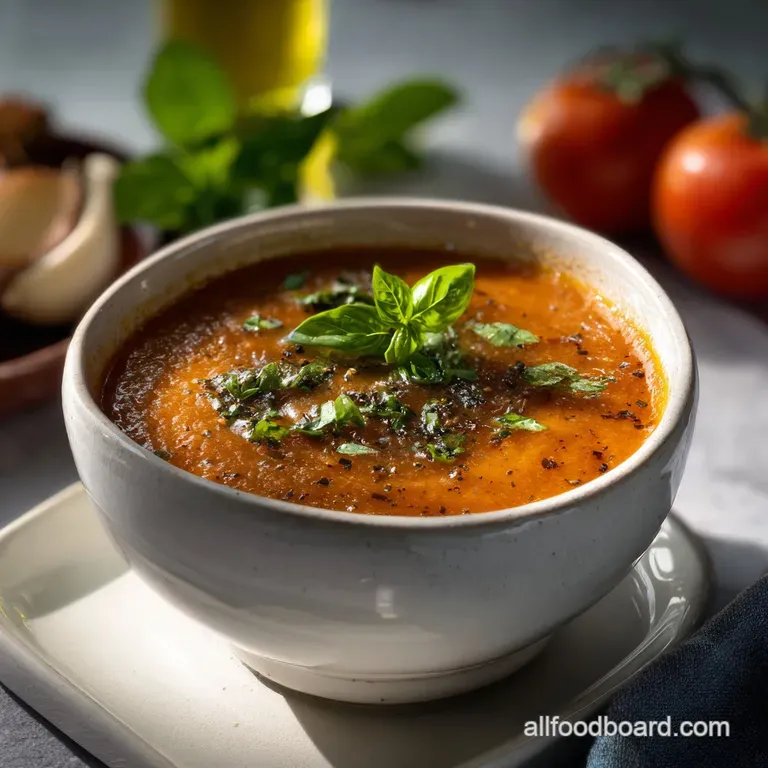
- Preheat your oven to 400°F (200°C) until the internal thermometer clicks, signifying a stable thermal environment.
- Arrange the 3 lbs Roma or Vine Tomatoes cut-side up on a baking sheet until the surface is fully covered but not crowded.
- Nestle the 1 head of Garlic (exposed top up) among the tomatoes until it sits securely against the pan.
- Drizzle with 3 tbsp Extra Virgin Olive Oil and season with 1 tsp Sea Salt and 1/2 tsp Cracked Black Pepper until every tomato surface glistens.
- Roast for 45 minutes until the tomato skins are wrinkled and dark mahogany char spots appear. Note: This char is the source of the "roasted" flavor.
- Sauté the 1 large Yellow Onion in 1 tbsp Olive Oil in a large pot for 8 minutes until the onion is translucent and the edges turn pale golden.
- Squeeze the softened cloves from the roasted 1 head of Garlic into the pot until the skins are empty and the aroma is nutty.
- Add the roasted tomatoes (and all pan juices), 2 cups Vegetable Stock, and 1/2 tsp Red Pepper Flakes until the liquid begins a gentle simmer.
- Stir in 1/2 cup Fresh Basil and 1 tbsp Balsamic Vinegar until the leaves wilt and turn bright emerald.
- Blend the mixture with an immersion blender for 3 minutes until the texture is completely velvety and no large skin fragments remain.
Managing Common Pitfalls
Why Your Soup Tastes Bitter
If your soup has a sharp, metallic, or bitter edge, it’s usually down to the garlic. If the garlic head isn't tucked between the moist tomatoes, the high heat can turn the sugars into carbon. Protein denaturation in the garlic happens quickly; once it passes golden brown into dark black, the flavor becomes acrid.
| Problem | Root Cause | The Fix | Pro Protocol |
|---|---|---|---|
| Bitter Aftertaste | Scorched Garlic | Add a pinch of baking soda | Wrap garlic in foil if roasting without enough tomato juice. |
| Grainy Texture | Improper Blending | Blend for longer or strain | Use a high speed blender for 2 full mins for molecular smoothness. |
| Too Acidic | Under ripe Tomatoes | Add 1/2 tsp honey | Roasting longer at a lower temp (350°F) can help develop sugars. |
⚗️ The Scaling Lab
When you decide to double this Roasted Tomato Soup Bliss with Fresh Basil and Garlic for a big family gathering, you have to respect the physics of the pot.
- The Evaporation Paradox: If you double the ingredients but use the same diameter pot, the surface area for evaporation stays the same. To avoid a watery soup, reduce the added vegetable stock by 10% (use 3.5 cups instead of 4).
- Pan Crowding: Do not pile 6 lbs of tomatoes on one sheet pan. They will steam instead of roast. Use two pans and rotate them halfway through to ensure the Maillard reaction hits every tomato.
- Flavor Saturation: Scale the 1/2 tsp Red Pepper Flakes to only 3/4 tsp when doubling. Spices accumulate heat non-linearly; it's much easier to add more at the end than to fix a soup that's too spicy for the kids.
- Thermal Mass: A double batch of cold tomatoes will drop your oven temp significantly. Increase your preheat time by 15 minutes to ensure the oven walls have enough stored energy to recover quickly.
Debunking Common Tomato Myths
Myth: You must peel the tomatoes before roasting for a smooth soup. Truth: The skins contain concentrated umami and flavonoids. Roasting them until they char adds depth, and a high speed blend incorporates them into the velvety texture perfectly.
Myth: Adding sugar is the only way to fix acidic tomato soup. Truth: Balsamic vinegar or a longer roast time actually balances acidity better. The acetic acid in vinegar masks the "sharpness" while the roasting develops natural fructose.
Preservation and Zero Waste Philosophy
- Fridge
- Store in an airtight container for up to 5 days. The flavor actually improves by day 2 as the aromatic compounds from the basil and garlic continue to infuse the liquid.
- Freeze
- This soup is freezer gold. Since there is no dairy, it won't break or grain. Freeze in heavy duty bags for up to 6 months.
- Reheating
- Heat on the stovetop over medium low. If it has thickened too much, whisk in a splash of water or stock to restore the emulsion.
💡 ZERO WASTE: Don't discard the basil stems! Transform: Throw the stems into your vegetable stock pot or simmer them with the soup, then remove before blending.
Science: The stems contain the same essential oils (linalool) as the leaves but with a more earthy, woody backbone that adds complexity to the Roasted Tomato Soup Bliss with Fresh Basil and Garlic.
Perfect Pairings for a Family Table
This soup is a chameleon. For a classic lunch, serve it alongside a grilled cheese made with sharp cheddar and sourdough. The lactic acid in the cheese complements the malic acid in the tomatoes beautifully.
If you want to keep things lighter, a crusty baguette rubbed with a raw garlic clove provides a shattering textural contrast to the velvety soup. For a more substantial dinner, a small side of Spicy Sausage Pasta creates a Mediterranean feast that uses the same aromatic profile. No matter how you serve it, remember that the "bliss" in this Roasted Tomato Soup Bliss with Fresh Basil and Garlic comes from the patience of the roast. Let the oven do the heavy lifting, and your palate will reap the rewards.
Recipe FAQs
Can I substitute fresh Roma tomatoes with canned whole peeled tomatoes?
Yes, canned whole peeled tomatoes work well. They must be thoroughly drained before roasting to prevent steaming instead of searing. If you enjoyed mastering the roasting technique here, see how we adapt the flavor profile using similar thermal principles in our Tomato Cream Sauce: Silky Vibrant Italian Recipe.
What causes the soup to taste grainy after blending?
Under blending allows large particulate matter to remain undissolved. High speed blending ensures the tomato pectin and roasted cell walls fully shear into a smooth suspension.
- Blend on high speed for two full minutes
- Ensure the immersion wand reaches all areas of the pot
- Add a splash of hot stock if the mixture is too thick to circulate
Is it necessary to roast the garlic head whole?
No, peeled cloves can be roasted separately. Roasting the whole head in its skin insulates the sulfur compounds, ensuring they caramelize slowly into sweetness rather than rapidly burning into bitterness. This method creates a deeper flavor base, similar to the slow rendering needed for Black Bean Soup Recipe: The Deep Flavoured Cuban Frijoles Negros Classic.
Should I use salted or unsalted vegetable stock?
Unsalted stock provides necessary salinity control. Salt content varies wildly between commercial stock brands, making standardization impossible. Unsalted stock allows you to accurately calibrate flavor based on the saltiness of your tomatoes and finishing herbs.
Can I make this soup ahead of time and freeze it?
Yes, freezing without dairy preserves quality excellently. Since this recipe contains no cream or butterfat that can separate upon thawing, it freezes perfectly flat. Thaw slowly in the refrigerator and reheat gently on the stovetop, adding water if the texture tightens.
Myth: Adding cream is the key to a silky texture.
Myth: Adding cream is the key to a silky texture. Reality: Roasting the tomatoes initiates pectin breakdown, providing a natural, starch free body that requires minimal added fat for a luxurious mouthfeel.
Is simmering the tomatoes better than roasting them?
Roasting achieves superior Maillard browning. Simmering cooks tomatoes via moist heat, which boils off water but locks in sharp, metallic acidity. Roasting utilizes dry heat to initiate sugar caramelization, building the deep umami foundation this soup requires for true "bliss."
Roasted Tomato Soup Bliss
Ingredients:
Instructions:
Nutrition Facts:
| Calories | 180 kcal |
|---|---|
| Protein | 3.2 g |
| Fat | 11.2 g |
| Carbs | 18.5 g |
| Fiber | 3.8 g |
| Sugar | 9.4 g |
| Sodium | 542 mg |
